The Man in My Headphones: What My Narrator Found Between My Lines
I have written a lot of heroes. I have outlined their jawlines, argued with them about their emotional availability, and deleted entire paragraphs because they were being too dramatic in a grocery store parking lot. I thought we were close. Then I sat in a recording booth in early 2026 and heard one of them speak for the first time. Reader, I gasped. Not a polite, authorial gasp. A hand-to-my-chest, thank-goodness-nobody-can-see-me gasp.
The First Time He Spoke, I Forgot I Wrote Him
Audiobooks are a strange and wonderful collaboration. On the page, my hero exists in a quiet little room in my head. He sounds however you hear him, which is the whole magic trick. In the booth, he gets a pulse. The narrator asks questions like, 'How does he feel about her in this scene?' and 'Is this line a threat or a promise?' and suddenly I am defending a fictional man’s emotional timeline like he is my actual boyfriend and we are late for dinner.
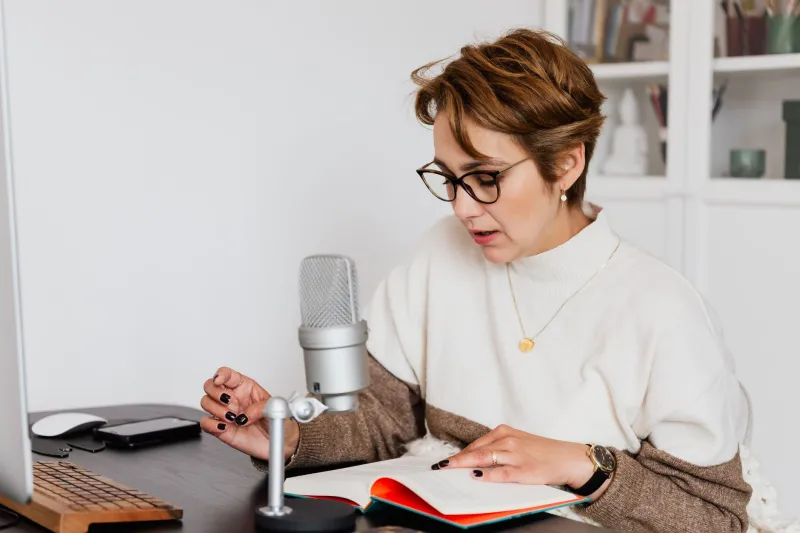
What I did not expect was the blushing. I sat behind the glass with a mug of coffee, wearing my most professional author cardigan, and listened to a man deliver a line I had written at my kitchen table in sweatpants. It was not even a spicy line. It was a quiet one. The kind where the hero tells the heroine exactly what he sees in her. The narrator slowed down. He dropped his voice. He made the words sound like they had been waiting all day to be said. I turned to the editor and whispered, 'Did I write that?' She nodded. I have never been more proud or more embarrassed in my life.
What a Narrator Hears That the Author Misses
Here is the secret: narrators are not just reading. They are interpreting. They are building a whole man out of punctuation. A comma can become a breath. An ellipsis can become a warning. A period can land like a door closing in a quiet house.
My narrator noticed things I had buried in the subtext. He asked why my hero always clears his throat before he lies. I had not realized he did it until it was pointed out. He asked whether a certain pause was hesitation or restraint. I said, 'Both,' and he said, 'Great, I’ll do it with my eyebrows.' And he did. I heard eyebrows in an audio file. This is the kind of sorcery that makes you believe in art.
There is also the matter of danger. On the page, I can write that a hero is dangerous and let the reader fill in the rest. Out loud, danger has a tempo. It has a volume level. It has a smile behind the words. The narrator found a version of one hero that was rougher than I intended, and I loved it so much I rewrote a scene in my next book to match what he had done in the booth. My editor called it 'method writing by osmosis.' I called it 'being shown up by a man with a microphone.'
The Line Delivery That Changed a Hero Forever
There is one line in my backlist that I will never hear the same way again. I wrote it as a throwaway. The hero is teasing the heroine, and he says something smug and soft. On the page, it was a three-second moment. In the recording, the narrator let it hang. He laughed under the words. He made it sound like a secret the hero was only just admitting to himself. I heard the entire relationship shift. I sat up so fast my cardigan slipped off the chair.
That is the collaboration nobody warns you about. The narrator is not a voice actor performing a script. He is a co-author of your hero’s inner life. He notices when a man is trying too hard. He notices when a man is scared. He notices when a man is pretending not to be in love. And because he notices, the listener gets a hero who feels lived in rather than assembled.
The Blush Is Part of the Process
I have now sat through enough recording sessions to know the schedule: coffee, headphones, a quick debate about how to pronounce a minor character’s last name, then the moment where everyone pretends not to watch the author’s face. I am not a subtle person. When a line lands, I react. I have fanned myself with a manuscript. I have texted my group chat from the booth. I have said, 'Okay, but he cannot be that hot on a Tuesday' while a professional narrator waited patiently for me to pull myself together.
But the blushing is useful. It tells me what is working. If I wrote a tender scene and the narrator makes me tear up, I know the emotional math is right. If I wrote a banter scene and the whole booth laughs, I know the rhythm is carrying. If I wrote a grovel and I feel my own shoulders drop, I know the hero has earned it. The audio version is like a live focus group with better acoustics and a much nicer chair.
What This Means for Your Next Listen
So when you press play on a romance audiobook in 2026, know that there was a room, a microphone, and at least one author trying not to make eye contact with her own imagination. Know that the narrator asked questions. Know that a single breath changed a hero. Know that I will never again write the word 'softly' without hearing someone do it better than I ever could.
And if you catch yourself blushing on the commute? Same. Welcome to the club. I wrote the book, and I still had to pull over.